
Rare solar radiation storm gives scientists clearest picture yet of flight risks
The most comprehensive dataset ever collected from Earth’s atmosphere during a solar radiation event has highlighted the importance of better-coordinated radiation monitoring for aviation safety, according to a new study led by the University of Surrey.

Launches of radiation monitors took place concurrently on 17 October 2025 at Met Office sites in Camborne and Lerwick in the UK
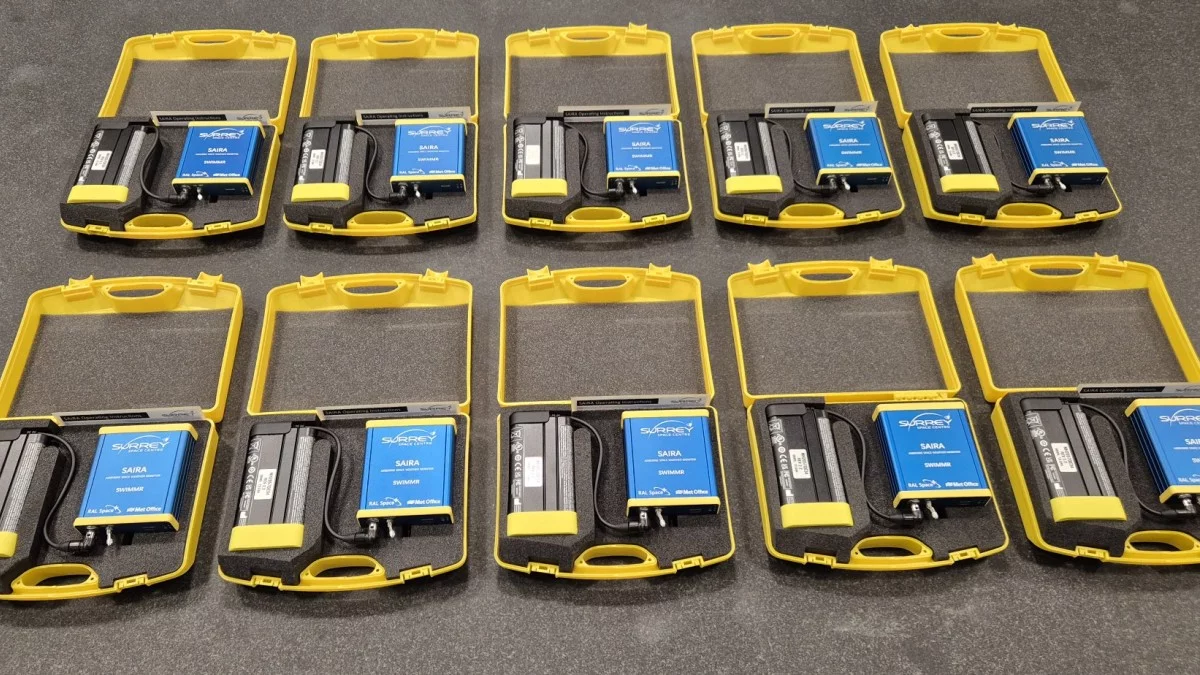
A number of the SAIRA monitors used on commercial planes
The study, published in Space Weather, analysed data collected on 11 November 2025 during the largest Ground Level Enhancement (GLE) observed in almost 20 years. Triggered by a rare X5-class solar flare, the event caused an intense burst of radiation particles from the Sun to penetrate Earth’s atmosphere and reach ground level.
Researchers combined readings from ground-based neutron monitors across the UK, detectors onboard transatlantic passenger flights and radiation monitors carried by weather balloons launched high into the atmosphere from the UK and the Netherlands.
The findings showed that radiation levels above the UK significantly varied depending on location and altitude. Weather balloons launched in collaboration with the Met Office from its site in Lerwick, Shetland, recorded radiation levels above the International Civil Aviation Organisation’s (ICAO) ‘moderate’ advisory threshold at business jet altitudes (higher than commercial jet altitudes) several hours after the storm peaked. At still-higher altitudes associated with supersonic flight, measurements exceeded the ICAO ‘severe’ threshold.
One London to New York flight that departed during the storm also experienced a 46 per cent increase in radiation exposure compared to normal background conditions.
The study emphasises the importance of combining direct atmospheric observations with the forecasting models currently used to assess aviation radiation risk during extreme solar radiation events. Current international advisory systems mostly rely on model outputs informed by ground and space-based observations.
I’d spent years studying these events, so when the alerts first came through, I assumed it would just be another small blip. But when I logged into the data stream and saw what was happening over Lerwick, I genuinely couldn’t believe it.Dr Fraser Baird, Co-lead on the study and Research Fellow at the Surrey Space Centre
“The first balloon launch from Lerwick recorded an extraordinary radiation environment high in the atmosphere. It shows just how geographically variable these events can be, and why having coordinated monitoring systems in place is so important for improving our understanding of radiation risks to aviation.
The project involved a collaboration of researchers from the Met Office and the Royal Netherlands Meteorological Institute (KNMI) – both partners on the space weather balloon launches – as well as Lancaster University and other international partners.
The findings could support future improvements in atmospheric radiation monitoring, particularly as airlines increasingly rely on sensitive electronic systems and more flights operate on high-latitude routes where radiation exposure is highest.
The data received during this event, both from the monitors on the ground and from the balloon launches, are vital for our understanding of how space weather impacts radiation levels throughout Earth’s atmosphere. This is the first time radiation data has been collected through the atmosphere during a space weather event in this way and this represents a big leap forward in scientific understanding and will make a real difference to our space weather forecasting capability.Krista Hammond, Met Office Space Weather Manager
The study also marks the first time the UK has been able to monitor a major solar radiation storm using a nationwide network of neutron monitors spanning from Cornwall to Shetland. Researchers say that just a decade ago, there were no such operational sensors in the UK.
###
Notes to editors
- Dr Ben Clewer and Dr Fraser Baird are available for interview; please contact mediarelations@surrey.ac.uk to arrange.
- The full paper can be found here: https://doi.org/10.1029/2026SW005279
Related sustainable development goals


Media Contacts
External Communications and PR team
Phone: +44 (0)1483 684380 / 688914 / 684378
Email: mediarelations@surrey.ac.uk
Out of hours: +44 (0)7773 479911