Surrey leads first nuclear science experiment with world's most advanced gamma-ray detector
Nuclear physicists at the University of Surrey have become the first to carry out a scientific experiment using the world's most advanced gamma-ray spectrometer – investigating a sudden change in the shape of the atomic nucleus that could challenge existing theories.

GRETA installed at the Facility for Rare Isotope Beams.
The experiment took place at the Facility for Rare Isotope Beams (FRIB) in Michigan, USA, using the newly delivered and characterised Gamma-Ray Energy Tracking Array (GRETA). Led by Lawrence Berkeley National Laboratory (LBNL) and delivered by a collaboration with Argonne National Laboratory, Oak Ridge National Laboratory and FRIB, GRETA is a $58 million detector designed to reveal the structure of atomic nuclei in unprecedented detail.
Working with collaborators from FRIB and Lawrence Berkeley National Laboratory, the Surrey team investigated a radioactive isotope of germanium to help answer a long-standing question about the shape of its atomic nucleus.
For many years, physicists predicted that the nucleus should resemble a rugby ball. However, more recent evidence has suggested it could instead be flattened like a disc – a result that would challenge current theories describing how protons and neutrons behave inside the nucleus.
GRETA uses highly segmented high-purity germanium detectors to detect, localise and track gamma rays emitted by unstable atomic nuclei, allowing scientists to study their structure with unprecedented sensitivity and precision. Compared with the detector originally planned for the germanium experiment, GRETA is around five times more efficient, meaning measurements can be completed faster and with far greater precision.
Because access to rare isotope beam facilities is limited, GRETA's efficiency enables scientists to study more exotic, short-lived isotopes within the available beam time.
Beyond Surrey's experiment, GRETA opens up new opportunities to study how the elements are formed in explosive astrophysical events and deepen scientists' understanding of how protons and neutrons interact within the atomic nucleus. Its exceptional sensitivity also allows researchers to detect tiny signals hidden within complex datasets and investigate increasingly rare isotopes that were previously beyond reach.
The completion of GRETA and the first installation for physics experiments is a major milestone. This is the result of years of effort from a very big team.Paul Fallon, GRETA project director and interim director of Berkeley Lab’s Nuclear Science Division
The experiment was led by Dr Jacob Heery, a postdoctoral research assistant at the University of Surrey, whose proposal secured the highly sought-after beam time after being selected by an international panel of experts.
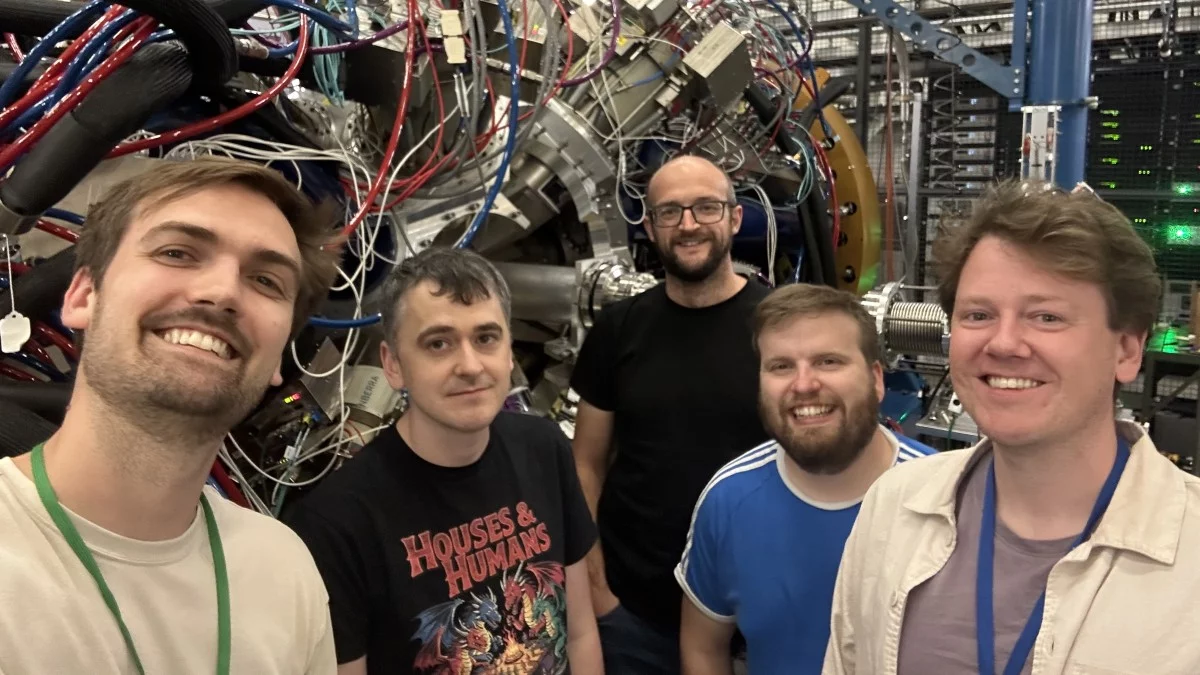
From left to right: Chris Cousins (Surrey), Stephen Gillespie (FRIB), Jack Henderson (Surrey), Tom Parry (FRIB - Surrey PhD), Daniel Doherty (Surrey). Dr Jacob Heery, who led the experiment, participated remotely.
Analysis of the experiment is now underway. The work formed part of the JANUS (Joint Arrays for Nuclear Structure) collaboration between FRIB, Lawrence Livermore National Laboratory and the University of Surrey. It also builds on Surrey's leadership of the £3.1 million FAUST project, which is developing a next-generation detector system that will operate alongside GRETA in future experiments.
Notes to editors
- Dr Jack Henderson is available for interview; please contact mediarelations@surrey.ac.uk to arrange.

Media Contacts
External Communications and PR team
Phone: +44 (0)1483 684380 / 688914 / 684378
Email: mediarelations@surrey.ac.uk
Out of hours: +44 (0)7773 479911