
Surrey spin-out develops algorithmic framework to boost mobile network connectivity and connect more devices without new masts
Mobile networks could carry more data and connect more devices from the masts already standing, using signal processing developed by Noema Signal Labs, a new spin-out from the University of Surrey.
The technology upgrades the algorithms inside existing equipment, so it needs no new antennas, spectrum or radio hardware.
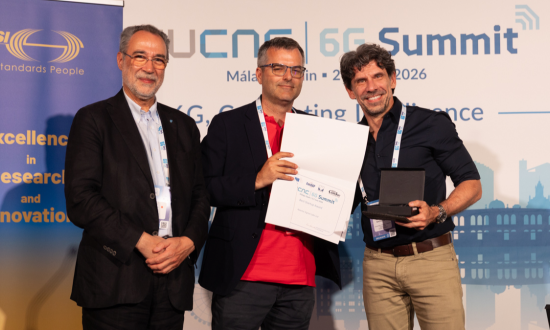
Founded by Konstantinos Nikitopoulos, Professor of Wireless Communications and Signal Processing at Surrey’s 6G Innovation Centre, Noema won the Best Startup Award at the 2026 EuCNC & 6G Summit in June, within months of being incorporated. It has since won a place on Deutsche Telekom's Tangible Tomorrow programme and has secured around £1.2 million of funding to bring the technology closer to market.
Phones that show a strong signal but will not load a page or send a message are a familiar frustration in busy city centres. A study commissioned by BBC London, reported in September 2026, found that more than one in four mobile data tests on streets near Covent Garden failed outright on a weekday evening. Off-peak tests performed far better, which points to congestion as the issue rather than a lack of coverage.
Operators usually meet rising demand by adding base stations, buying spectrum and installing larger antenna arrays that draw more power. Each approach raises upfront costs, running costs and energy use.
Noema takes a different approach. Conventional base stations use linear signal processing, which divides the overlapping radio signals from many phones into simpler streams so they can be decoded quickly, but leaves part of the channel's capacity unused. Noema's patented non-linear processing technology decodes the signals together. It works alongside radio resource management (RRM) software, which decides how a network shares its airwaves between users. The technology replaces the algorithms inside base stations, Wi-Fi access points, satellite systems and mobile devices, without new radio hardware or antennas and without changing how devices talk to the network.
On a 5G Open RAN system built to 3GPP standards and tested with commercial devices, Noema's first-generation technology delivered more than 200 per cent higher throughput, connected more than 300 per cent more devices and used 50 per cent fewer antennas and underlying radio circuitry. Open RAN lets operators combine equipment and software from different suppliers, while 3GPP is the partnership that sets global mobile standards.
Noema’s technology could let operators meet rising demand with less infrastructure, spectrum and power, cutting costs and emissions while improving service. Noema sees uses across public, private, defence and satellite networks. The technology could also support industrial automation and physical AI that require constant connectivity, where robots and machines sense and act in the real world.

Noema was incorporated in March 2026. In June, Professor Nikitopoulos pitched the company at the EuCNC & 6G Summit in Málaga, Spain, where it won the Best Startup Award. At the same event, he and Chathura Jayawardena won the Best Poster Award for research on connecting devices directly to satellites.
In October, Noema joined Tangible Tomorrow, a programme run by hubraum, Deutsche Telekom's tech incubator, with T-Labs. The programme connects start-ups and spin-outs with Deutsche Telekom's business and technology teams to explore and speed up commercial collaboration.
Professor Nikitopoulos' Engineering and Physical Sciences Research Council (EPSRC) New Investigator Award funded the foundational research at Surrey’s 6GIC. Innovate UK and the UK Government, through the Department for Digital, Culture, Media and Sport (DCMS) and later the Department for Science, Innovation and Technology (DSIT), then supported its development, including NL-COMM, a project funded through the Small Business Research Initiative (SBRI) Future Telecommunications challenge.
In 2025, Surrey and test equipment company Keysight demonstrated the technology, then known as NL-COMM, at Mobile World Congress in Barcelona, as one of 33 showcases presented by O-RAN Alliance participants. The University also supported the spin-out process and funded and managed the patents behind Noema's technology.
Noema shows what patient, publicly funded research can realise. The University backed this work from the first research grant, through to protecting the IP, developing the commercial proposition and forming the company. In its first months, Noema has won a European award and a place on a highly selective Deutsche Telekom programme. We are working with more brilliant Surrey researchers to follow the same path from lab to market.Dr Jim Shaikh, Managing Director of Innovate Surrey Ltd
Innovate Surrey Ltd leads the commercialisation of research at the University of Surrey. It helps Surrey researchers to turn their intellectual property into real-world impact through licensing and creating spin-outs, spin-ins, start-ups and scale-ups. Once companies are formed, they receive ongoing support through the Surrey Innovation District, which brings together Surrey Research Park, the University's incubation and acceleration programmes and its work with regional innovation clusters.
###
NOTES TO EDITORS
- Professor Konstantinos Nikitopoulos is available for interview. Please contact mediarelations@surrey.ac.uk to arrange.
Featured Academics
Media Contacts
External Communications and PR team
Phone: +44 (0)1483 684380 / 688914 / 684378
Email: mediarelations@surrey.ac.uk
Out of hours: +44 (0)7773 479911