
Quantum computing is coming for business – are we ready?
University of Surrey’s Dr Athina Ioannou and Prof Rafał Wojakowski recently interviewed Prof Wojciech Bożejko, a leading computer scientist at Poland's Wrocław University of Science and Technology, to explore what quantum computing really means for business education and practice.


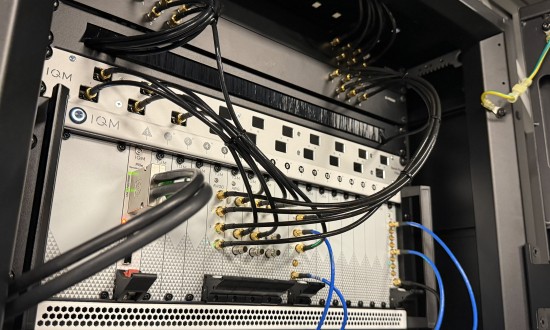
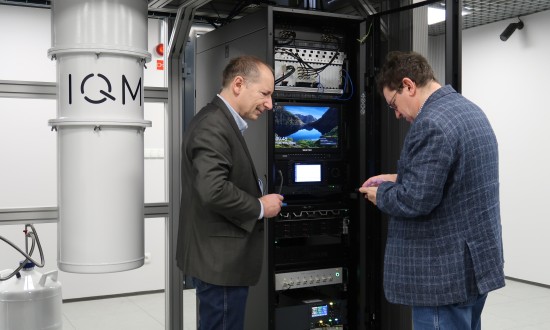
As part of this collaboration, Rafał also visited the university's Centre for Networking and Supercomputing in Wrocław, where he had the opportunity to see Odra 5 – the first quantum computer installed and fully operational in Poland.
Why quantum computing?
Quantum computers differ radically from classical machines. Instead of processing information step by step, they use qubits that can exist in multiple states simultaneously, allowing them to explore vast solution spaces in parallel. While today's devices are still limited in scale, progress is accelerating, and their business impact is no longer a distant prospect.
Impact for data privacy and cybersecurity
The most immediate implications are likely to appear in data privacy and cybersecurity. As quantum computers grow more powerful, they may eventually undermine today's widely used encryption standards, affecting digital identities, online banking, and blockchain technologies. At the same time, quantum systems offer true randomness by design, opening new possibilities for secure key generation and cryptographic protocols. For businesses, understanding both the risks and opportunities of quantum technology is becoming essential for reshaping strategies around digital trust.

Impact for business analytics
Equally important are the consequences for business analytics. Quantum methods show strong potential in complex optimisation, advanced simulations and rapid large-scale data analysis combined with pattern discovery – areas where classical computing faces exponential slowdowns. Importantly, quantum computing will not replace classical systems overnight. Hybrid systems, combining classical AI with quantum acceleration, are likely to emerge first as a practical pathway for organisations.

Impact for financial applications
In finance, quantum computing promises faster and more efficient approaches to portfolio optimisation, risk management, and Monte Carlo simulations used in option pricing and stress testing. While quantum machines are unlikely to deliver exact solutions to hard financial problems, they may dramatically improve the speed and quality of approximate solutions – often sufficient for real-world decision-making.

Quantum tools for students and businesses
Importantly, quantum computing is not "only for physicists." Access to today's quantum devices already relies on familiar Python-based tools, and the level of physics required is modest. This makes the technology far more accessible than many would assume and positions quantum literacy as becoming increasingly relevant for business students, particularly in business analytics, finance, fintech, and digital transformation.
Quantum revolution
The message from the interview is clear: the quantum revolution is approaching and will affect the business world sooner than many expect. Students, professionals and future business leaders who understand its principles, applications, and limitations will be better prepared to navigate the next major shift in computing.


The original version of the interview is available from the authors upon request.
Special thanks to Lukasz Wojakowski for facilitating the visit and providing the photographs.
Authors also thank Fabio Dias, Victoria Milligan and Mark Shackleton, for their support, encouragements and helpful conversations.
Related sustainable development goals


