
Battery-free nanosensors could pave the way for next-generation wearables
Nanosensors that work without batteries or wires could pave the way for more comfortable, less obtrusive sleep and healthcare monitoring at home, according to scientists at the University of Surrey.
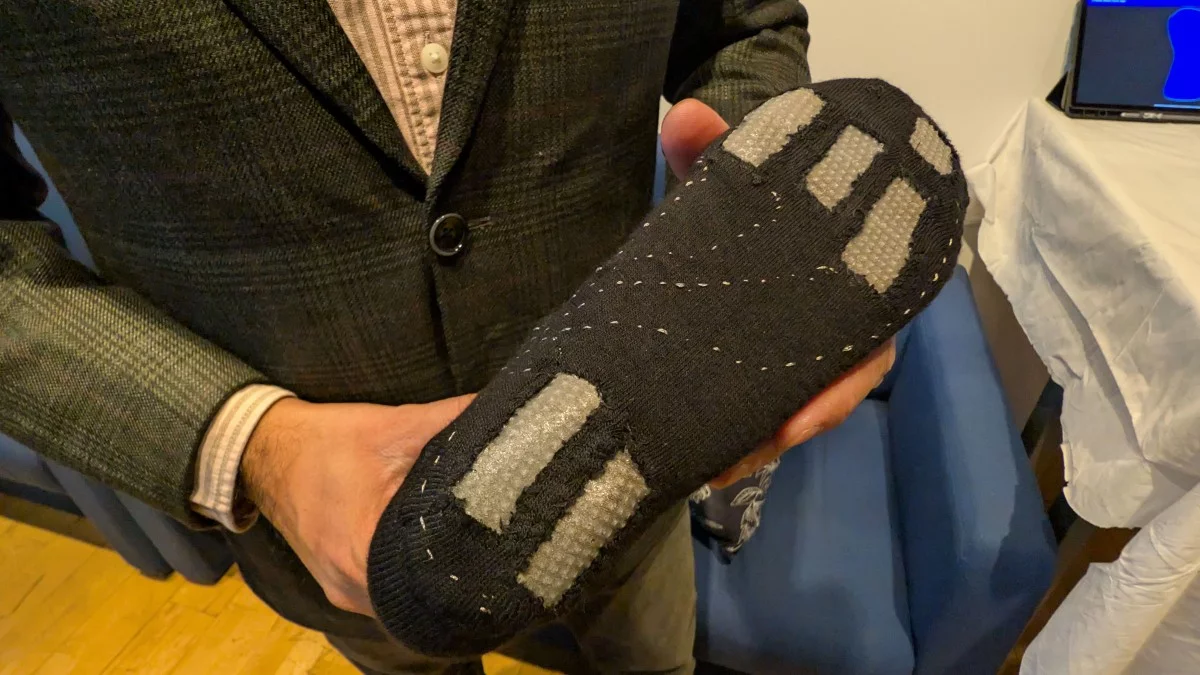
Unlike conventional systems used in smartwatches and other wearables, which depend on batteries and regular charging, the technology is designed as a soft sensor mat that can be integrated into clothing or next-generation wearables, harvesting its own power from gentle movements such as breathing, walking or turning during sleep.
Developed at Surrey’s Advanced Technology Institute (ATI), researchers tested a set of 16 sensors that were able to track different sleep patterns and body movements, highlighting potential applications in sleep disorder monitoring and dementia care – where comfort, reliability and continuous data collection are vital.


The research, published in Advanced Materials, demonstrates one of the most sensitive self-powered pressure sensors reported to date for low-frequency human motion. The device is based on an ultra-thin nanofiber structure made by embedding a boron-based two-dimensional nanomaterial – known as borophene – into a flexible polymer using an electrospinning process.
When pressure or movement is applied, the material generates its own electrical signal, removing the need for batteries. The signals produced are strong enough to power low-energy electronics, opening up possibilities for long-term, maintenance-free monitoring in healthcare, wearables and smart environments.

The research also underpins the vision behind Z-PULSE, a Surrey spin-out company working to translate advanced materials research into real-world, zero-burden healthcare monitoring technologies.

###
Notes to editors
- Sajib Roy and Professor Ravi Silva are available for interview; please contact mediarelations@surrey.ac.uk to arrange.
- The full paper can be found here: https://advanced.onlinelibrary.wiley.com/doi/10.1002/adma.202521626
Featured Academics
Media Contacts
External Communications and PR team
Phone: +44 (0)1483 684380 / 688914 / 684378
Email: mediarelations@surrey.ac.uk
Out of hours: +44 (0)7773 479911