
Sustainable breakthrough in low-cost materials for next-generation energy harvesting
A new sustainable approach to energy harvesting could transform how wasted heat is turned into electricity, thanks to a breakthrough in low-cost, flexible materials developed by researchers at the University of Surrey’s Advanced Technology Institute (ATI).

Thermoelectric devices generate electricity from temperature differences, offering a way to capture large amounts of wasted energy from industrial processes, electronics and even the human body. This kind of energy harvesting is already used in some instances to power small sensors, wearable devices and Internet of Things (IoT) devices without batteries, but the most efficient materials used today are typically expensive, brittle and difficult to recycle.
In a new study, published in Advanced Energy and Sustainability Research, the research team outline a new way of designing thermoelectric materials using metal–polymer superlattices – ultra-thin layered structures that boost performance while avoiding the cost and environmental impact of conventional materials.
Researchers combined thin metal layers with a widely used organic polymer, called PEDOT:PSS – improving performance by up to 100 times compared to the base material. They also showed that by selecting different metals, they could control whether the material behaves as a p-type or n-type semiconductor – a key requirement for building practical thermoelectric devices.

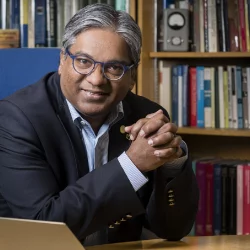
The research offers a scalable and more sustainable alternative to traditional thermoelectric materials, opening new possibilities for powering everyday devices and even future space missions. The findings also highlight the potential of combining advanced nanostructures with sustainable materials to help tackle global energy challenges – especially the urgent need to recover waste heat, given that roughly 80 per cent of global energy input is lost as low-grade waste heat.
###
Notes to editors
- Professor Ravi Silva and James G. Neil are available for interview; please contact mediarelations@surrey.ac.uk to arrange.
- The full paper can be found here: https://advanced.onlinelibrary.wiley.com/doi/10.1002/aesr.202500479
Related sustainable development goals


Featured Academics
Media Contacts
External Communications and PR team
Phone: +44 (0)1483 684380 / 688914 / 684378
Email: mediarelations@surrey.ac.uk
Out of hours: +44 (0)7773 479911