
Two Surrey professors elected IEEE Fellows for 2026
Two leading professors from the University of Surrey’s School of Computer Science and Electronic Engineering have been elected Fellows of the Institute of Electrical and Electronics Engineers (IEEE), effective January 2026.

Professor Wenwu Wang (Left) and Professor Liqun Chen (Right)
Fellowship of the IEEE is one of the highest honours in the global engineering community, awarded to fewer than 0.1% of voting members each year and reserved for individuals with an exceptional record of achievement across IEEE’s fields of interest.
Professor Liqun Chen, Professor in Secure Systems, is recognised “for contributions to applied cryptography, trusted computing and their standardisation.”
Professor Wenwu Wang, Professor in Signal Processing and Machine Learning in the Centre for Vision, Speech and Signal Processing (CVSSP), receives the distinction “for contributions to audio classification, generation and source separation.”
Professor Chen has more than 30 years’ experience in applied cryptography and co-developed Direct Anonymous Attestation (DAA) – a cryptographic scheme that allows hardware devices to prove trustworthiness without revealing the user’s identity. The DAA paper, published at the ACM Conference on Computer and Communications Security in 2004, received a Test of Time Award a decade later, and her collaborative work on DAA now focuses on post-quantum algorithms.
Since joining Surrey in 2016, she has led seven EU Horizon projects and contributed to major UK-funded programmes, including EPSRC and NCSC projects, using trusted computing and distributed ledger technologies to achieve security and privacy in real-world applications.
Professor Chen has also played a long-standing role in an international standard working group for cryptography and security mechanisms, contributing to ISO/IEC standards as an editor or co-editor, and helped to initiate new standards. She has also been involved with the Trusted Computing Group (TCG) for more than 25 years, starting as a Hewlett-Packard expert, and helped develop key TPM algorithms and specifications.
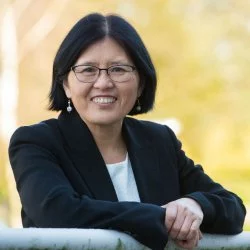
Professor Wang’s primary contributions centre on advanced methods for sound classification, generation and source separation – enabling machines to interpret and synthesise complex acoustic scenes. A Fellow of the Surrey Institute for People Centred AI, his research has significantly advanced audio separation in challenging real-world environments with overlapping background noise, and he has played a leading role in developing foundational audio models, large audio-language models and resources, including the influential PANNs model for sound recognition, the AudioLDM family of generative audio models, and the widely used WavCaps dataset – alongside multimodal audio-visual and audio language approaches for source separation.
Professor Wang’s work has had a wide impact across academia and industry, particularly in signal processing, machine learning, audio engineering, and detection and classification of acoustic scenes and events (DCASE), inspiring new directions and applications in related fields. His work has been recognised with numerous international awards, including multiple DCASE Challenge honours and the IEEE Signal Processing Society Young Author Best Paper Award.


[ENDS]
Notes to editors
- Professors Wenwu Wang and Liqun Chen are available for interview; please contact mediarelations@surrey.ac.uk to arrange.
Featured Academics
Media Contacts
External Communications and PR team
Phone: +44 (0)1483 684380 / 688914 / 684378
Email: mediarelations@surrey.ac.uk
Out of hours: +44 (0)7773 479911