Perceptions and Effects of Gender-Based Violence Subversive Humor (HUMOR-GV)
Overview
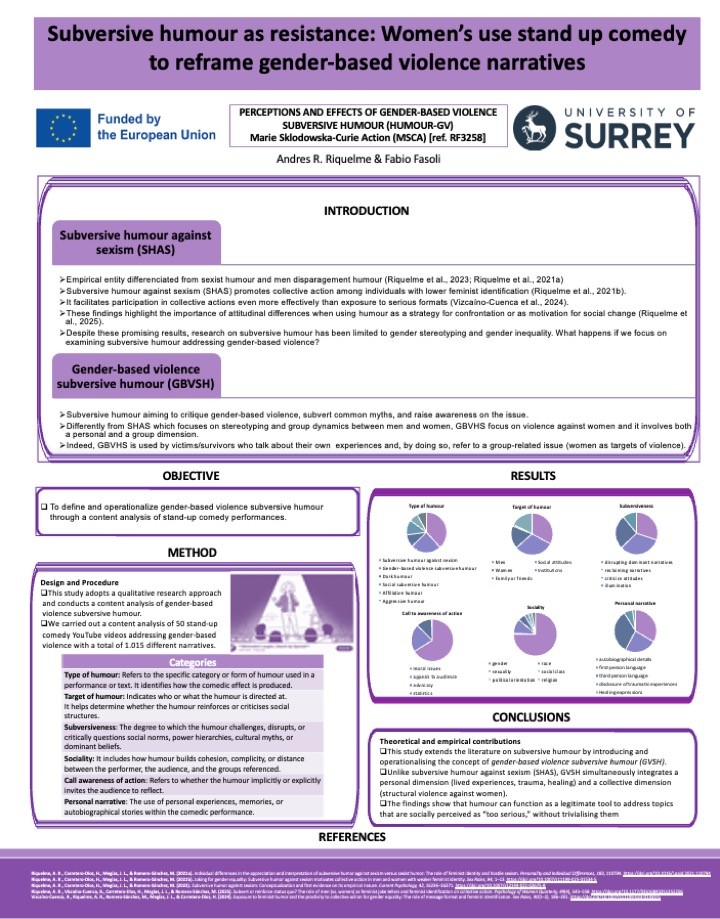
Gender-based violence continues to affect countless women, often perpetuated by harmful stereotypes and misconceptions. In a creative twist, some survivors are using humour to challenge these narratives. Gender-based violence subversive humour (GVSH) gives victims a platform to reclaim control and spark conversation through stand-up comedy and personal jokes.
Supported by the Marie Skłodowska-Curie Actions programme, the HUMOR-GV project explores this emerging form of expression, investigating how GVSH is crafted, delivered, and received by audiences. The project also looks at how it helps deconstruct myths, raises awareness, and supports survivors’ well-being. By offering new insights, HUMOR-GV aims to promote social change and create a more inclusive society where humour helps dismantle the stigma surrounding gender-based violence.
Aims and objectives
This project employs mixed methods to:
- Understand how GVSH is conceptualised, delivered by victims, and perceived by the audience.
- Examine the positive effects of GVSH on deconstructing gender-based violence myths, raising awareness, and motivating people to fight gender-based violence.
- Investigate how women who have been victims and are survivors of gender-based violence appreciate, use, and positively benefit in terms of wellbeing from GVSH.
Funder
Related sustainable development goals


Team

MSCA Postdoctoral fellow
Dr Andres Riquelme Riquelme
Marie Skłodowska-Curie Fellow
Biography
I completed my PhD at the University of Granada (Spain). In 2025, I joined the University of Surrey as a Marie Skłodowska-Curie Fellow. The research project focuses on Gender-Based Violence Subversive Humour (GBVSH), a creative strategy often used by victims themselves to express and confront the abuse and violence they experience in various contexts, such as intimate partner relationships.

Supervisor
Dr Fabio Fasoli
Associate Professor in Social Psychology
Biography
I received my PhD in 2011 from the University of Trento (Italy). After that, I held postdoctoral fellowships at CITEC/University of Bielefeld, the University of Padua, ISCTE-IUL, and the University of Milano-Bicocca. In October 2016, I joined the University of Surrey as a Marie Sklodowska-Curie Fellow and have been here ever since. I am the Programme Leader for the Social Psychology MSc, the co-director of the Sex, Gender, and Sexualities Research Centre. I am the Communication Officer for the International Association of Language and Social Psychology (IALSP)
Research groups and centres
Our research is supported by research groups and centres of excellence.
News
Turning the Tables: Raise Awareness for International Day of the Elimination of Violence Against Women Through Subversive Humour

Every year, on 25 November, the International Day for the Elimination of Violence against Women provides an opportunity to raise awareness of the violence that women continue to experience worldwide, across different cultures and societies. Violence against women is one of the most devastating forms of human rights violations and encompasses a wide range of manifestations, including physical, sexual, psychological or economic violence (World Health Organization, 2026).
It therefore includes a broad spectrum of behaviours and experiences that can sometimes be difficult to identify. Bourdieu (2001) uses the term symbolic violence to describe forms of domination exercised through representations, social norms and cultural practices that reproduce and legitimise power relations and inequalities, often in subtle and invisible ways. Moreover, it can take place in both public and private settings. An example of violence in the private sphere can be found in the research conducted by Barbier et al. (2022) where among 40,357 women from 28 different EU countries, the 51.7% reported having been victims of intimate partner violence in their lifetime. In contrast, violence in the public sphere includes, for example, street harassment, which, according to Bowman (1993), encompasses behaviours ranging from leering and winking to unwanted comments and catcalling.
Violence against women contributes to the foundations of gender inequality, at the most extreme end of which lies femicide. Fear, guilt, social stigma, financial dependence and isolation, as well as concerns about not being believed or receiving support, can prevent women from reporting abuse or leaving an abusive relationship. Furthermore, it is essential to address violence against women by recognising the diversity of women's experiences and ensuring that prevention, intervention and support initiatives respond to their different circumstances and needs (Humbert & Strid, 2025).
Among the different strategies for confronting violence, humour represents an interesting and quite useful strategy. Although humour and comedy have historically been used to reinforce stereotypes and prejudices against women, thereby reinforcing gender inequality, as illustrated by Daniel Tosh's jokes about rape in 2012, or sketches that trivialised and portrayed domestic abuse against women as funny, such as those performed by the Spanish comedy duo Martes y Trece in the 1990s, humour can also be used in the opposite direction. In other words, it can be used with the aim of changing power relations, confronting sexism and myths about gender-based violence, and challenging the discourses that reinforce, sustain and trivialise it.
In recent years, many feminist female comedians have taken to the stage to challenge this type of violence, drawing also on their personal experiences. Representative examples include Adrienne Truscott (Asking for It), Cameron Esposito (Rape Jokes) and Hannah Gadsby (Nanette). Their work helps bring violence against women into the public arena as an issue of public concern, while also reaching particular audiences. Through these performances, rather than positioning survivors as objects of ridicule, their narratives focus on criticising ideologies, myths and dominant narratives, as well as confronting perpetrators. In this way, humour emerges as a double-edged tool that can be used both to confront and to cope with violence against women. Indeed, humour may foster solidarity, empathy and empowerment among women who have experienced this type of violence (Sundén & Paasonen, 2019), although its effects will always depend on individual differences in cognition, personality and preferences for particular humour styles.
In this context, the University of Surrey is committed to promoting gender equality and reduced inequalities, as well as addressing forms of sexual violence that disproportionately affect women. This commitment includes developing research, strategies and tools to address violence against women. Research on humour can play a vital role in deepening our understanding of violence and identifying innovative approaches to addressing it. It is precisely within this area that the HUMOR-GV project (Gender-based Violence Subversive Humour), funded by the European Commission's Marie Skłodowska-Curie Actions programme, is situated. The project investigates the potential of subversive humour related to gender-based violence as a form of expression, resistance and social critique. It explores how this humour is created and performed, how audiences receive and interpret it, and its potential psychosocial effects. It also examines how humour can challenge myths and misconceptions about gender-based violence, encourage bystander engagement and collective action, and contribute to female survivors' well-being.
What is gender-based violence subversive humour?

What is gender-based violence subversive humour? Watch this video to see comedians talking about it
Outputs
Conference Presentations

Posters