
Transforming school travel in Surrey: A behavioural systems approach
Led by Professor Benjamin Gardner, the project developed a behavioural systems map informed by the recommendations that arose from the first phase of the Active School Travel Project in 2025. The project aligned with three United Nations Sustainable Development Goals (UN SDGs), SDG 3, SDG 11 and SDG 13.

The challenge
Last year, Surrey County Council commissioned the Institute for Sustainability to examine the effectiveness of School Travel Plans (STPs) in Surrey schools. STPs are formal strategies designed to promote active travel among caregivers, children, and school staff; however, there was no clear guidance on how to measure their impact. The Institute’s project team developed a set of indicators to support assessment, enabling a clearer understanding of the extent to which STPs influence active travel behaviour and the reasons behind these changes. The findings informed the creation of a dedicated evaluation tool—the STEP tool (School Travel Effectiveness of Planning)—to measure the effectiveness of STPs (learn more about the last year’s Active School Travel project).
With the Department for Transport aiming for 60% of children aged 5–16 to travel actively to school by 2035, Surrey County Council is working to promote and increase active travel among students, staff, and families across the school community.
Our approach
The first project highlighted the need for a systems-based approach, emphasising collaboration between multiple stakeholders—including schools, local communities, and local government—to effectively design, implement, and evaluate active travel initiatives. As a follow-up to the first project, the second phase focused on developing a behavioural systems map of active school travel (AST) across Surrey. The map is designed to provide a comprehensive understanding of the complex interactions between stakeholders, behaviours, and the wider infrastructure and systems that influence AST. By identifying how these factors influence one another, the project aimed to support evidence-based decision-making and help determine which stakeholders and behaviour changes should be prioritised to increase levels of AST across the county.
What we did
The project comprised two work packages: Literature review and expert consultation and mapping.
Literature review
The project team reviewed published studies and grey literature sources, which helped to identify a broad range of stakeholders, beyond parents/caregivers and children, whose actions influence AST. Key actors included central and local government departments, police, urban designers and third-sector organisations.
The team also presented two case studies that show how stakeholders could be involved in AST projects. One case study showed how stakeholders can be fully involved by helping to understand the factors that affect AST and by taking part in planning and delivering an AST programme. The other case study highlighted the benefits of having a key person in the system (for instance, a “community animator”) who helps bring people together, improves communication between different groups, and supports positive changes in attitudes and behaviours towards active school travel in schools.
Expert consultation and mapping
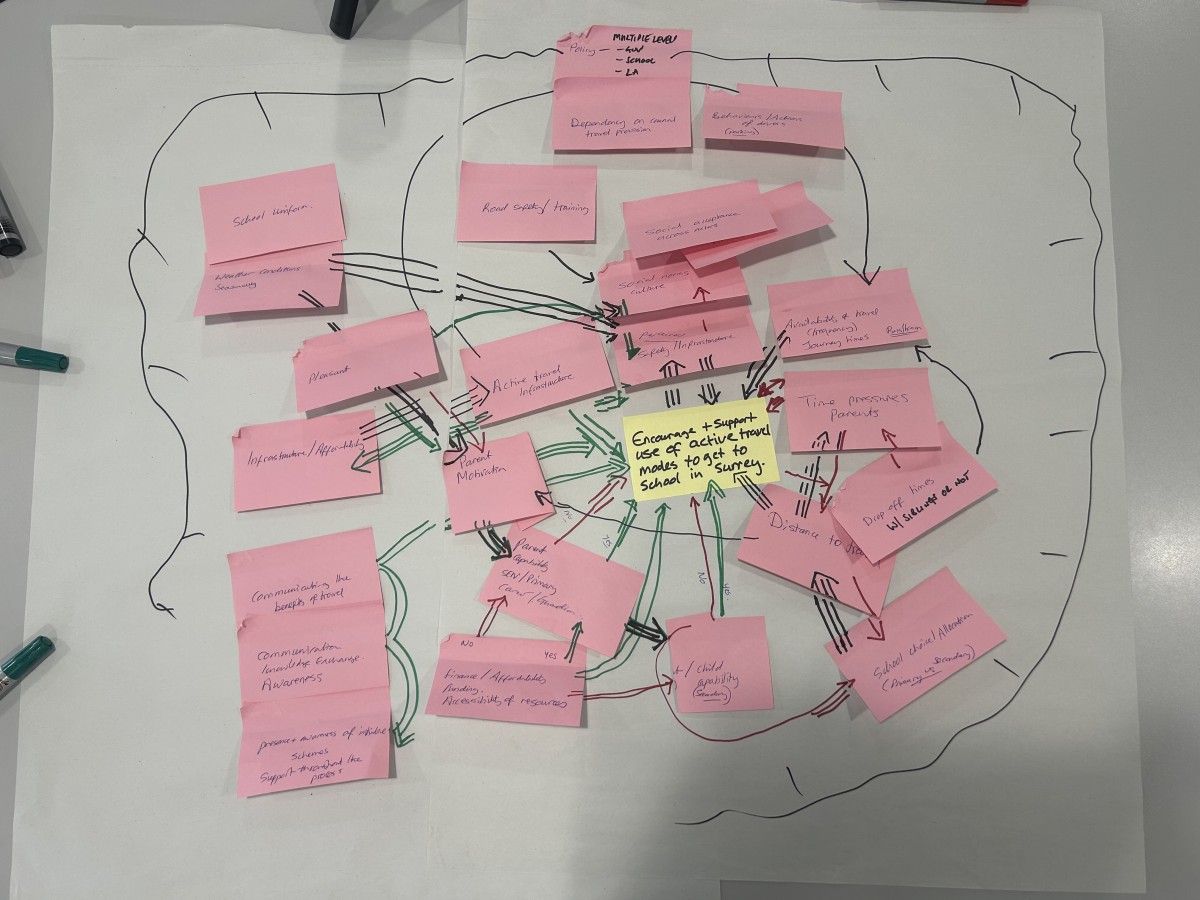
The project team conducted two stakeholder workshops and a series of interviews with 30 stakeholder representatives to collaboratively develop a behavioural systems map. Participants included local government officers from relevant teams (Safer Travel, Parking Enforcement, and Road Safety & Sustainable School Travel), representatives from third-sector organisations (Active Travel England and Walk Wheel Cycle Trust), as well as parents and staff from local schools.
During the first stage, stakeholders identified the main barriers and facilitators influencing AST in Surrey. Key barriers included the distance between home and school, time pressures experienced by parents, and concerns about traffic levels and driver behaviour.
In the second stage, stakeholders refined a list of relevant stakeholders and potential actions, which were organised into ten clusters. These clusters distinguished between activities required for systems-level leadership, such as securing funding and coordinating efforts across sectors, and actions aimed at addressing the barriers identified in the first stage, including infrastructure maintenance and skills training. The final stage involved synthesising these findings into a comprehensive systems map that linked stakeholders and behaviours with the wider barriers affecting AST.
Never before have we understood how the interlinking parts of the behavioural system truly influence active school travel. This is something that will continue to grow organically over time as we map more of the system and bring those connections together.Jonny Ray, Senior Safer Travel Officer, Surrey County Council
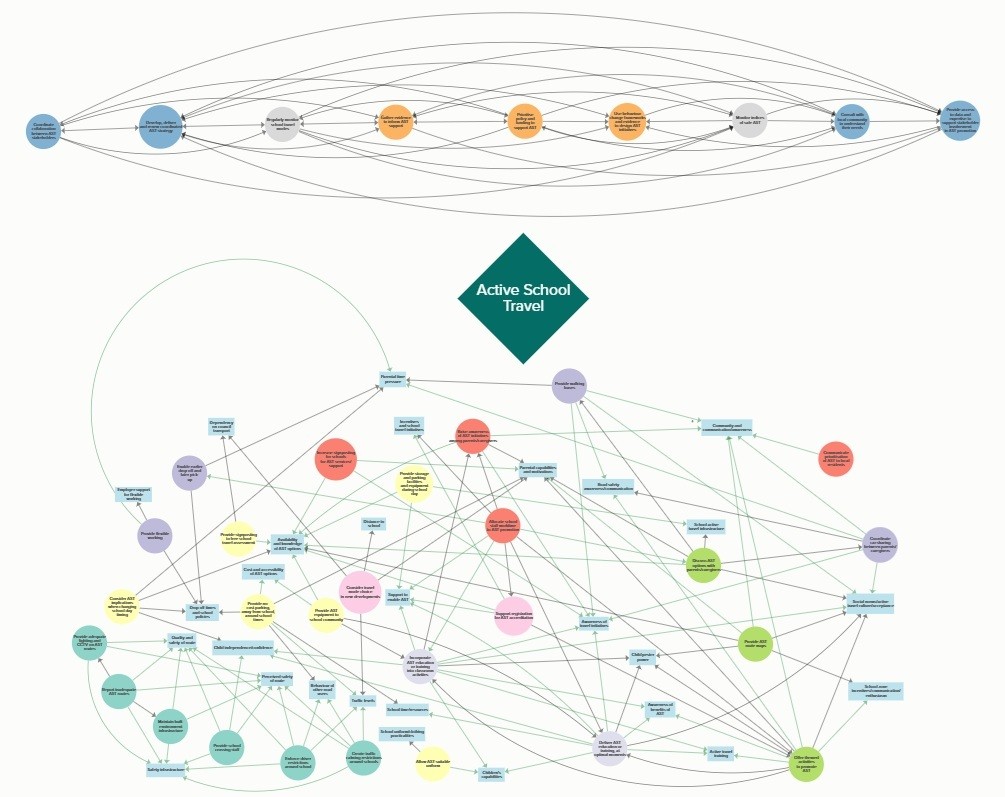
Figure 1. Behavioural systems map of active school travel in Surrey.
Check out the live systems map.
Next steps
The behavioural systems map provides a useful starting point for developing AST initiatives. It can help generate ideas for action and encourage further discussion about the most effective points in the system for creating change. The next stage is to put the map into practice by using it to guide decision-making about where interventions should be targeted and which stakeholders should be involved. This will help support greater participation in active school travel among children in Surrey.
To learn more about the project, read the report (PDF).

Sustainable Development Goals
The project addresses three key UN SDGs:
- SDG 3 (Good Health and Well-being): The project contributes to good health and well-being as it encourages children, parents, caregivers and staff to engage in regular physical activity through walking, cycling or scooting to school.
- SDG 11 (Sustainable Cities and Communities): The project supports the development of sustainable cities and communities by promoting more sustainable and accessible travel options for school journeys. It encourages the development and maintenance of active travel infrastructure, helping to create safer and more accessible routes for children and families. The project also fosters collaboration between schools, local authorities, parents, and community organisations, supporting a coordinated approach to improving the safety, quality, and sustainability of local environments.
- SDG 13 (Climate Action): The project supports climate action as it encourages a shift from car use to lower-carbon travel modes, helping to reduce transport-related emissions. It also supports long-term behaviour change towards more sustainable travel habits among children and families.
Read the latest on the University of Surrey’s UN SDG report.
Contributors
The project team

- Professor Benjamin Gardner is a leading expert in behaviour change research. His expertise in understanding how habits influence everyday behaviours—particularly those relating to health and environmental sustainability—provided valuable insights and made a significant contribution to the project.
- Dr Valentine Seymour is an expert in sustainability assessment. The project benefited from her expertise and research interest in multi-layered systems mapping, particularly in understanding the relationships between systems, stakeholders, and behaviours.
- Annabel Rivers-Stone and Sophia Shaw-Brown supported the project as Research Assistants, contributing their expertise in behaviour change and its adoption. They were involved in undertaking the literature review, facilitating stakeholder workshops, and developing the behavioural systems map.
- Professor Benjamin Gardner, Professor in Psychology, School of Psychology, University of Surrey
- Dr Valentine Seymour, Lecturer in Sustainability Assessment, School of Engineering, University of Surrey
- Annabel Rivers-Stone, Research Assistant, School of Psychology, University of Surrey
- Sophia Shaw-Brown, Research Assistant, School of Psychology, University of Surrey
- Catherine Cole, Innovation Lead, Sustainability Innovation Hub, Research, Innovation, and Impact, University of Surrey
- Haeyoung Eun, Innovation Lead, Sustainability Innovation Hub, Research, Innovation, and Impact, University of Surrey
- Peter O’Reilly, HDRC Research Lead, Quantitative, Surrey County Council
- Rebecca Harrison, Safer Travel Team Leader, Surrey County Council
- Jonny Ray, Senior Safer Travel Officer, Surrey County Council
- Domhnall McFarline, Safer Travel Officer, Surrey County Council.

The Institute for Sustainability facilitates collaborations between scientific experts and organisations. The Institute’s Sustainability Innovation Hub provides expert voices from the Fellows to nurture ideas, encourages collaboration, and supports organisations in the adoption of sustainable practices, products or services.
This project aligns with the Improving Health and Wellbeing for All programme at the Institute for Sustainability.
This work was commissioned by the Safer Travel Team and supported by the Health Determinants Research Collaboration Surrey (HDRC Surrey). The authors wish to acknowledge Rebecca Harrison (Safer Travel Team Leader), Peter O'Reilly (HDRC Research Lead, Quantitative), Domhnall McFarline (Safer Travel Officer) and Jonny Ray (Senior Safer Travel Officer).
Related sustainable development goals


