

Environmental Flow (EnFlo) Laboratory
The Environmental Flow (EnFlo) Laboratory hosts various fluid mechanics research and teaching facilities, including a world-leading meteorological wind tunnel, several other wind tunnels and a fully-automated laboratory measurement instrumentation suite.
Overview
Established in 1993 with funding from EPSRC, National Power, the UK Meteorological Office and the University of Surrey, EnFlo is an internationally recognised centre of excellence in atmospheric boundary layer flows and environmental aerodynamics.
The lab is home to a large and unique facility, the EnFlo boundary-layer wind tunnel, which is the only one in the UK capable of simulating wind characteristics in non-neutral conditions, including stable and convective (unstable) boundary-layer flows. It hosts two other large conventional wind tunnels and a series of smaller wind tunnels for testing, instrument calibration and teaching purposes.
Measurement capabilities include 3-component velocity and turbulence, mean and fluctuating tracer concentration, pressure and temperature, forces and moments.
Wind tunnels
EnFlo Wind Tunnel
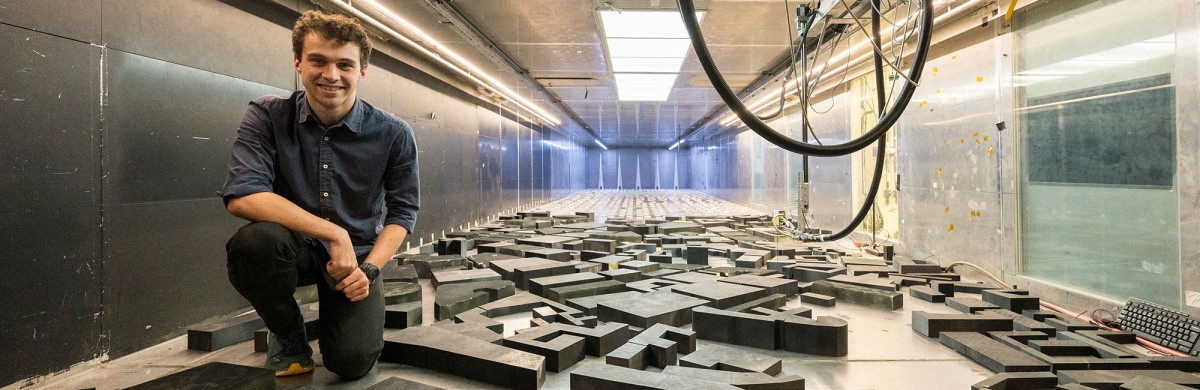
This wind tunnel is EnFlo's main facility and it is also part of the National Wind Tunnel Facility. At 20 metres long it features a comprehensive inlet flow and surface heating and cooling systems for generation of neutral, stable and unstable boundary layers and neutral and stable free flows.
Other key features include two three-dimensional, computer-controlled traversing gears, tracer supply systems, calibration facilities, a turntable and extensive condition monitoring. The tunnel and all associated capabilities operate under full computer control, enabling prolonged unmanned operation.
| Specifications |
|
|---|---|
| Dimensions |
|
| Air speed range |
|
| Inlet heater |
|
| Roof/floor panel performance |
|
| Side panel performance |
|
Aero Tunnel
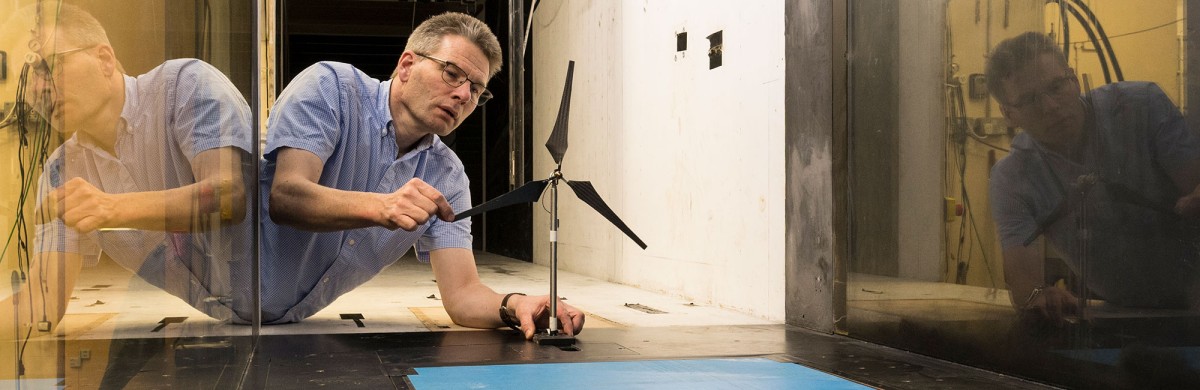
A 1.1 x 1.4 m test-section recirculating (closed-loop) wind tunnel facility with maximum speed of 40 m/s, featuring a rolling-road capability, full (nonintrusive) floor-to-ceiling, fully-automated particle-image velocimetry and laser-Doppler anemometry scanning capability, a six-component force balance, a five-axis traversing system and a suite of other fully-automated instrumentation systems for quick-turnaround, high-yield experimental testing, including a static test rig to prepare models.
| Specifications |
|
|---|---|
| Dimensions |
|
| Air speed range |
|
‘A’ Tunnel
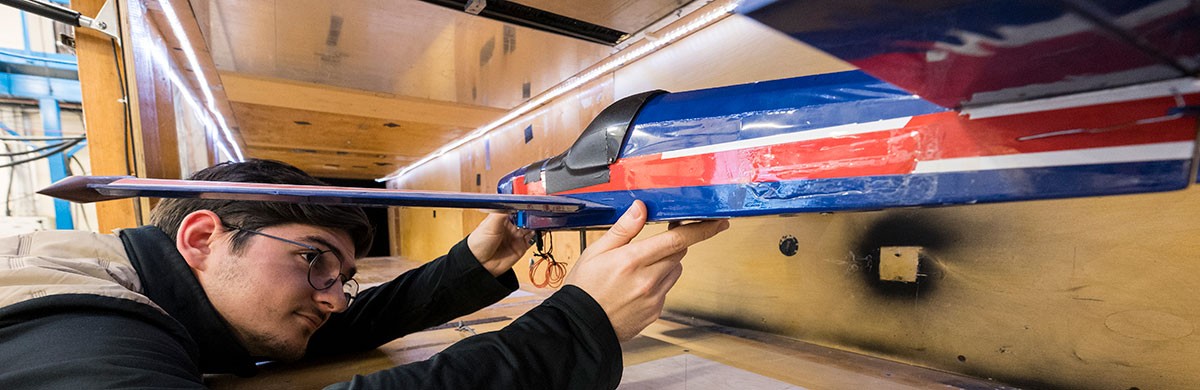
A 0.9 x 0.6 m test-section open circuit wind tunnel facility with a free-stream turbulence intensity <0.1%, used primarily for rapid testing, calibration and validation.
| Specifications |
|
|---|---|
| Dimensions |
|
| Air speed range |
|
Other wind tunnels and smaller rigs
The EnFlo lab features several other smaller rigs (small wind tunnels, water tanks, bench-sized facilities), including:
| ‘C’ Tunnel |
|
|---|---|
| ‘D’ Tunnel |
|
Available instruments and services
- Force measurements (6-component force balances)
- A wide range of pressure sensors and post-processing capabilities, including low-speed measurements
- 3-D laser Doppler anemometry (LDA)
- Multiple 2-D and 1-D laser Doppler anemometry systems
- Hot-wire (and X-wire) anemometry
- Tracer concentration measurements, including fast response instruments (>200 Hz) by means of fast-response Flame Ionisation Detectors (FFID)
- Stereo particle image velocimetry (PIV)
- A wide range of flow visualisation capabilities.

An urban model tested in the EnFlo meteorological wind tunnel.

Testing a car model in the Aero tunnel with the rolling road.

Aircraft stability testing in the A tunnel.

Twin fans driving the flow in the EnFlo meteorological wind tunnel.

Undergraduate laboratory demonstrations.

One of the fast-response flame ionisation detectors (FFID) measuring tracer concentrations in the wind tunnel.

Wind turbine testing in the Aero tunnel.
Find an expert

Dr Matteo Carpentieri
EnFlo Lab Director

Dr Paul Hayden
Lab Manager