MicroStructural Studies Unit and Surface Analysis Laboratory
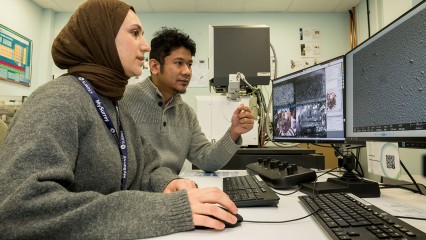
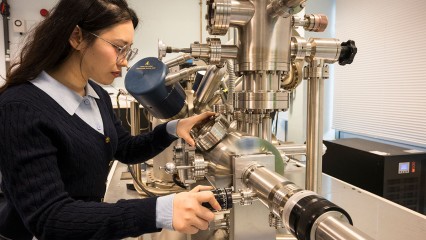
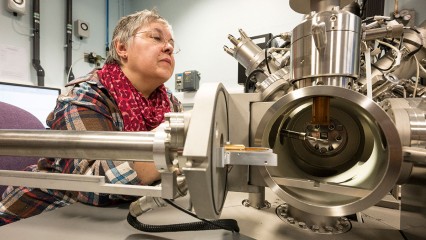
Our laboratory contains the most complete cluster of surface analysis instrumentation for X-ray photoelectron spectroscopy (XPS), time-of-flight secondary ion mass spectrometry (ToF-SIMS), scanning auger microscopy (SAM) and scanning probe microscopy (SPM) in Europe.
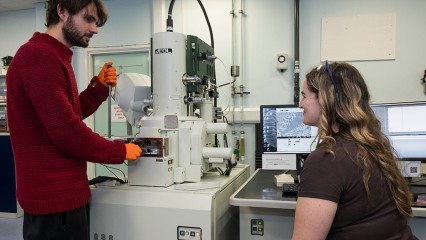
Our MicroStructural Studies Unit (MSSU), the electron microscopy facility of the University of Surrey, was established in 1970 to support a wide range of research activities across the University and to offer electron microscopy services to industry.
Overview
Surface analysis
The installed capital value of the instruments in our laboratory is of the order of £3 million and we have state-of-the-art instruments for scanning auger microscopy and X-ray photoelectron spectroscopy.
Microstructural unit
After decades of continuous development, we employ experienced microscopists and house a comprehensive range of state-of-the-art instruments such as, scanning electron microscopes (SEM), X-ray microanalysis techniques, transmission electron microscope (TEM), hardness testing, optical microscopy, and sample preparation equipment.
Our unit is essential for a wide range of ongoing research projects and makes a significant contribution to undergraduate and postgraduate teaching. Research activities are numerous but presently include advanced metallurgical structures, materials ageing, perovskites, nanomaterials, thin films (including biofilms), novel inorganic materials, and more!
We work closely with our colleagues in the School of Chemistry and Chemical Engineering who can provide X-ray diffraction (XRD) alongside a range of spectroscopic techniques for materials analysis.
We also work with industry, with work including product development, failure analysis, process problems, contaminant identification, verification of material composition and so forth.
Available instruments
Surface analysis
Standard, large area XPS instrument equipped with an XR4 twin anode X-ray source, an Alpha 110 analyzer and an Ar ion gun for sample etching. The instrument includes a sample preparation chamber which may be used for a range of in-situ and in-vacuo experiments and sample preparation procedures. UPS spectroscopy is also available on this instrument.
A high spatial resolution (12 nm) Scanning Auger Microscope with simultaneous EDX analysis. XPS and BSE facilities are also available on this multi-technique instrument.
The instrument includes a preparation chamber which may be used for a range of in-situ and in-vacuo experiments and sample preparation procedures, including a fracture stage for metal and composite samples.
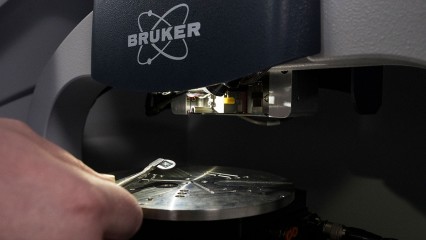
The Laboratory has been active in SPM since 1992. Our equipment includes a Bruker Dimension Edge AFM system with PeakForce tapping mode and Kelvin Probe capabilities, the Nanoscope III (Multimode) for fundamental studies and in-situ electrochemical experiments, both in air and in liquids, and a MDT Solver with magnetic force microscopy (MFM) facilities as well as conventional AFM capable of being used under ambient or in-vacuo conditions.
A state-of-the-art small spot (15 µm) XPS instrument with a monochromated X-ray source and Ar ion gun for depth profiling. Excellent spatial resolution, sensitivity and energy resolution.
The instrument has parallel angle resolved XPS (PARXPS) capability enabling the acquisition of non-destructive depth profiles. The instrument now includes a preparation chamber which may be used for a range of in-situ and in-vacuo experiments and sample preparation procedures.
A high spatial and mass resolution ToF-SIMS instrument incorporating a polyatomic Bi ion source. Additional Cs and C60 ion sources are installed on this instrument as depth profiling etch sources although they may also be employed as analysis sources.
The instrument includes a preparation chamber which may be used for a range of in-situ and in-vacuo experiments and sample preparation procedures. In-situ stages for impact and controlled strain rate testing of materials are currently installed on the preparation chamber. The instrument also possesses heating and cooling stages in the entry lock and analysis chamber.
Microstructural studies

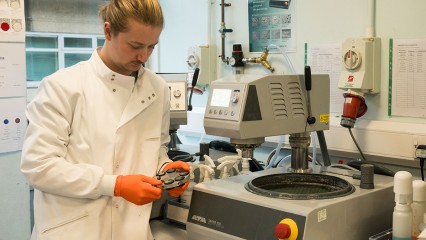
The unit has cutting equipment to prepare specimens of various sizes and all material types with high degree of accuracy and minimising any heat affection. We have the ability to mount samples for analysis in epoxy resin, Bakelite thermoset plastic and acrylics.
The samples are then prepared using our modern grinding and polishing kit capable of preparation of metallics, ceramics, polymers, and minerals to a sub-micron finish. The techniques we employ include semi-automatic grinding and polishing on an array of abrasive clothes and discs. We have vibro-polishing which is perfect for improving EBSD pattern quality and more. All performed by highly trained metallographic preparation technical staff. We can also chemically etch for microstructural analysis.

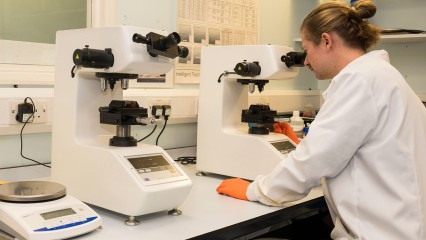
We have a variety of hardness testing apparatus which can support industry clients in a range of applications from failure analysis to quality assurance testing. We have the capability to perform both macro and micro Vicker’s hardness testing, Knoop hardness testing, and Rockwell hardness testing.
Please talk to a member of the team if you want to discuss specific applied loads during testing.
The University can also provide other mechanical tests.

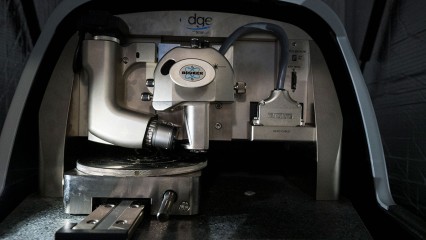
The JEOL JSM-7100F is a highly versatile, easy-to-use analytical field emission gun scanning electron microscope (FEG-SEM). It has a spatial resolution of 1.2 nm at 30 kV. The MSSU microscope is fitted with a ThermoScientific triple analysis system, featuring an UltraDry EDS detector, a MagnaRay parallel beam WDS spectrometer and a Lumis system for electron backscatter diffraction (EBSD).
All three analytical functions are integrated into a single ThermoScientific data system called Pathfinder to allow integration between these three complementary techniques.

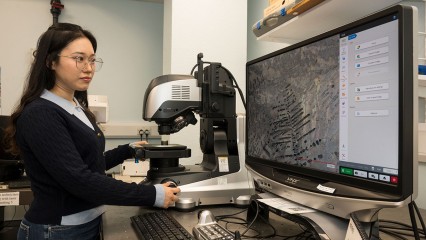
Easy to use top-range digital optical microscope with variable magnification up to 4000x. Can be operated using reflected or transmitted light. Variety of segmented coaxial or ring lamp illumination with 3-axis stage movement to provide larger area high resolution tile scans and/or 3-D information. Polarising and Differential Image Contrast (DIC) options available. Post processing options for dimensional measurements, contamination/grain size/shape analysis. Surface topology, including waviness and roughness, can be investigated.

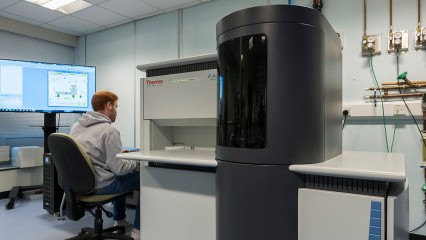
The ThermoScientific Apreo FEG-STEM offers high-performance imaging and X-ray analysis. It can achieve a spatial resolution of about 1 nm. The chamber allows for larger specimens to be observed than older, more traditional SEMs. Due to developments in low-voltage imaging technology, the Apreo can image beam-sensitive materials at accelerating voltages as low as 200 Volts and a current of 1.6 pA. This allows for easy imaging of nanomaterials, plastics/polymers and beam-sensitive materials like perovskites.
With ThermoScientific ChemiSEM Technology – a unique live elemental imaging capability – EDS compositional information is always readily and quickly accessed through an easy-to-use interface. A range of external and in-lens detectors can display images simultaneously, giving excellent resolution across a wide range of accelerating voltage.
The ThermoScientific Talos 200Fi is capable of both transmission (TEM) and scanning transmission (STEM) analysis. It is equipped with a high brightness FEG source (XFEG) and a high-resolution XTWIN lens, allowing single angstrom imaging resolution. Images are captured on a direct-electron detector camera (Ceta 16M, with up to 4k x 4k pixels) and smart acquisition routines, such as drift-compensated frame integration. In STEM mode, a Panther segmented STEM detector allows 5 simultaneous imaging modes, with complementary morphological and structural information about the sample. Elemental information can be mapped with nearly atomic resolution using a Dual X EDX system, which also designed for efficient collection during tomography.
How we can help you
Surface lab
We offer our services to industry and academia for involvement in research projects or problem solving on a daily pro-rata basis.
Our experienced academics and technical staff have expertise in data interpretation and vast materials knowledge, which along with our state of the art instruments will mean they can select the right combination of techniques for undertaking materials related research and development or solving technical problems.
If you have a particular research problem and would like further information on sponsoring a PhD project where a student can come work for you then contact a member of staff in your area of interest. You can also find further information on becoming a sponsor for our EngD course on the EPSRC Centre for Doctoral Training in Micro- and NanoMaterials and Technologies (MiNMaT) website.
Microstructural unit
Internal research
We offer support to all levels of study here at Surrey, be it undergraduate projects, postgraduate research, or post-doctoral research using our high-end analytical x-ray microanalysis and imaging techniques. We serve the entire University for all its electron microscopy needs.
External services
In the past few years, we have undertaken work for more than 50 different clients. We have worked to develop links with the local community, and we are proud to offer electron microscopy services to many technological businesses and research organisations in the Southeast of England.
Our portfolio of clients encompasses both the public and private sector, and their custom is highly valued. We offer competitive rates for SEM, STEM and TEM analytical work.
Surface analysis lab
Surface analysis techniques can be used to solve problems in a huge range of areas, some of which are listed below.
- Adhesive failure analysis/delamination
- Identification of surface contamination
- Assessment of cleaning procedures
- Elemental composition – bulk and surface
- Chemical state information
- Material identification and verification
- Micro or nano particle analysis
- Thin film analysis
- Metal passivation and corrosion
- Grain boundary segregation in metals
- Surface segregation
- Protective coatings and paints
- Identification of stains and discolorations
- Polymer surface functionality before and after various treatments
- Oxide film thickness
- Surface ultra-thin film thickness
- Depth profiles of thin film components
- Defect identification
- Molecular identification of lubricants, additives, and contaminants
- Catalysis
Are the techniques destructive?
Both X-ray photoelectron spectroscopy (XPS) and auger electron spectroscopy (AES) are considered non-destructive techniques. Sample damage may occur on those sensitive to the high energy x-rays or electron beam.
Time-of-flight secondary ion mass spectrometry (ToF-SIMS) removes the outer few nanometers of material for analysis but is considered non-destructive for most samples.
If depth profiles are desired, argon or other ion etching is employed; this leads to the removal of several hundred nanometers of material.
Minimum detectable concentration of an element
The minimum detectable concentration of most elements in both X-ray photoelectron spectroscopy (XPS) and auger electron spectroscopy (AES) is 0.1at. per cent although heavy elements can be detected at lower levels. Time-of-flight secondary ion mass spectrometry (ToF-SIMS) provides a level of detection in the ppm region.
Microstructural Studies unit
We use a mixture of imaging techniques to characterise materials including both in-lens and out-lens secondary and backscatter electron detection alongside complementary X-ray microanalysis techniques including energy dispersive spectroscopy (EDS or EDX), wavelength dispersive spectroscopy (WDS) and electron backscatter diffraction (EBSD) for advanced characterisation.
Are the techniques destructive?
SEM, EDS, WDS and EBSD are potentially non-destructive techniques depending on the samples – some material needs a conductive sputter coating or modification for observation via an electron beam.
Our newest SEM can hold samples much larger than traditional SEM samples due to a large chamber design, thus lowering the need to cut samples down to size.
TEM/STEM requires advanced sample preparation resulting in a significant change to the sample.
Minimum detectable concentration of an element
The limit of detection for EDS (for most elements) is 0.1 weight % and for WDS it is 0.02 weight %, but it does vary with the atomic number of the element and the nature of the material it is in. Typically, EDS analysis error is quoted as being ±2% relative for major components.
Surface analysis lab
As each problem is unique our fees will vary depending upon:
- The analysis techniques required
- The level of analysis or information required
- The difficulty of sample preparation
- Sample type and sample number
So we can't give specific quotes until we have discussed your needs. However an initial discussion with our Laboratory Manager will be free of charge.
Discounts
For those companies that are sponsoring MSc or PhD students or our Engineering Doctorate researchers, discounts are given on the cost of analysis. For significant analysis requiring several days of instrument time a discount may also be applicable.
Examples
An example of a variation in costs would be, the analysis of metallic samples in XPS where a surface composition is only required without any chemical state information can be completed faster and more easily than the analysis of insulators where chemical state information is desired.
Another example with varying costs is analysis in our Auger microscope, the elemental composition of a nanoparticle can be obtained far faster than the composition of a fracture interface fractured in vacuo.
Microstructural Studies unit
As each problem is unique our fees will vary depending upon:
- The analysis techniques required
- The level of analysis or information required
- The difficulty of sample preparation
- Sample type and sample number.
We can provide hourly prices on request, but we can’t give specific quotes until we have discussed your needs. However, an initial discussion with our Laboratory Manager will be free of charge and then a formal quote will be provided for your consideration.
Examples
An example of a variation in costs would be, the analysis of metallic samples in XPS where a surface composition is only required without any chemical state information can be completed faster and more easily than the analysis of insulators where chemical state information is desired.
Another example with varying costs is analysis in our Auger microscope, the elemental composition of a nanoparticle can be obtained far faster than the composition of a fracture interface fractured in vacuo.
Surface analysis lab
Initial discussion
You are welcome to visit the Laboratory and discuss your requirements in person, or you can send our Laboratory Manager, Dr Steven Hinder an email.
The laboratory staff will always be clear about our capability, facilities, analysis timescale and the results you can expect from the analysis.
Detailed quote is given
If it is decided to go ahead with an investigation a description of the proposed work and a detailed quote will be sent to you for approval.
Collecting and sending your samples
As the surface of samples is so easily contaminated, please, while wearing gloves, wrap the samples securely in fresh aluminium foil and then place in ziplock sample bags. Samples should be clearly labelled individually with a number or other reference if they are sent in a batch.
Our maximum sample size is determined by the size of the vacuum gate valves in our equipment. For XPS and SIMS this is 5x5x2cm and for AES this is 3x3x2cm. A wide range of sample preparation can be carried out on site to ensure a sample is a suitable size for analysis.
You can bring the samples here to the Laboratory in person, or send them to us by post at:
Surface Analysis Laboratory
University of Surrey
Guildford
Surrey
GU2 7XH
The analysis
Typically analysis is completed within one to two weeks from when the sample is received. However if the results are needed urgently then a rush can be achieved and analysis is completed in a few days.
Receiving your data
Once the analysis is complete the data that is collected is considered to be your property and is confidential. A copy will be sent to you and the original files can either be archived for up to two years or deleted at your request. Your samples can be returned should you require them.
Microstructural Studies unit
Initial discussion
You are welcome to visit the MSSU Facility and discuss your requirements in person, or you can email our Unit Manager, James Whiting at j.d.whiting@surrey.ac.uk.
The laboratory staff will always be clear about our capability, facilities, analysis timescale and the results you can expect from the analysis.
Detailed quote is given
If it is decided to go ahead with an investigation, a description of the proposed work and a detailed quote will be sent to you for approval.
Despatching your samples
Samples should be contained in a sealable bag or container for transport to avoid contamination. Samples should be clearly labelled individually with a number or other reference if they are sent in a batch.
Typically, SEM samples are less than 30 mm diameter, but our newest SEM can hold much larger specimens. Please talk to one of our technicians for more information.
You can arrange to bring the samples here to the Laboratory in person, or send them to us by post at:
FAO James Whiting
FEPS-SOE,
University of Surrey,
Guildford,
Surrey,
GU2 7XH
The analysis
Samples can be precision cut, mounted in a range of materials (Bakelite thermoset plastic, epoxy resin, acrylic), gold sputter coated, carbon coated, ground and polished to a sub-micron finish suitable for microscopy (and EBSD if required) and electropolishing.
Delivery time
Typically, analysis is completed within one to two working weeks from when the sample(s) is/are received. Faster turnaround can be discussed with our staff and may be possible if a quicker delivery of results is required.
Receiving your data and confidentiality
Once the analysis is complete the data that is collected is considered to be your property and is confidential. A copy will be sent to you and the original files can either be archived for up to two years or deleted at your request. Your samples (and excess material) can be returned should you require them via Parcelforce post. Any written or printed notes will be shredded after the completion of the work. All samples will be stored securely and can be stored in a locked cupboard upon request.
Find an expert
If you would like to use our services then please email our laboratory managers to discuss your problem. Alternatively, join us on LinkedIn, questions and queries are welcome.
Dr Steven Hinder
Surface Analysis Laboratory Manager
James Whiting
Microstructural Studies Unit Technician and Manager