

Jacqueline Bleicher
Academic and research departments
Centre for Environment and Sustainability, Global Centre for Clean Air Research.About
My research project
Urban Design led Urban Transformation for Post 2020 Climate Change Resilient Sustainable Urban NeighbourhoodsThe study aims to understand how Urban Designers are utilising, adapting, or evolving Urban Design principles to design climate change resilient and sustainable urban neighbourhoods for various regional contexts. Additionally, the study interprets Urban Designers’ visions of what should be designed for sustainable urban neighbourhoods of 2040, that respond to regional climate change hazards, identified by the Intergovernmental PaneI on Climate Change (IPCC, 2023).
Urban Design principles utilised to address specific climate hazards vary by the urban scale, context or region (Shukla, Das, & Mazumder, 2023). The significance of identifying appropriate and regional preferences for guiding urban design principles which influence the form and shape of a resilient, sustainable urban built environment (Lehmann, 2016; Jedwab, Loungani, and Yezer, 2021; Shukla, Das, and Mazumder, 2023) takes on new importance, as the Intergovernmental Panel on Climate Change (IPCC) advise that three-point-three to three-point-six billion human lives are endangered by climate change (IPCC, 2023).
Considering the risk posed by climate change hazards, there is a need for jurisdictions and built environment professionals, especially Urban Designers, to proactively transform existing urban human settlements and design new urban neighbourhoods that are climate change resilient, sustainable, and prepared for climate change related population density fluctuations due to relocation and migration.
Measures to adapt to climate change integrates sustainable, climate resilient design and development, including advance and planned relocation of vulnerable human settlements, with actions to reduce or avoid emissions and provide wider benefits for all including: improving peoples’ health and livelihoods; reducing poverty and hunger; clean energy, water and air (IPCC, 2023).
The study also investigates with climate scientist’s spatial strategies to mitigate and adapt to the regional climate change hazards identified by the Intergovernmental Panel on Climate Change (IPCC, 2023). Collaborations between urban Climate Experts and Urban Designers who design the built environment (Lenzholzer et al.,2020), are urgently required to accelerate the translation of regionally relevant climate change scientific knowledge, into accessible Urban Design strategies.
Many thanks to Supervisor Professor Prashant Kumar and Associate Professor Alireza Behnejad for their help and support with this study.
Supervisors
The study aims to understand how Urban Designers are utilising, adapting, or evolving Urban Design principles to design climate change resilient and sustainable urban neighbourhoods for various regional contexts. Additionally, the study interprets Urban Designers’ visions of what should be designed for sustainable urban neighbourhoods of 2040, that respond to regional climate change hazards, identified by the Intergovernmental PaneI on Climate Change (IPCC, 2023).
Urban Design principles utilised to address specific climate hazards vary by the urban scale, context or region (Shukla, Das, & Mazumder, 2023). The significance of identifying appropriate and regional preferences for guiding urban design principles which influence the form and shape of a resilient, sustainable urban built environment (Lehmann, 2016; Jedwab, Loungani, and Yezer, 2021; Shukla, Das, and Mazumder, 2023) takes on new importance, as the Intergovernmental Panel on Climate Change (IPCC) advise that three-point-three to three-point-six billion human lives are endangered by climate change (IPCC, 2023).
Considering the risk posed by climate change hazards, there is a need for jurisdictions and built environment professionals, especially Urban Designers, to proactively transform existing urban human settlements and design new urban neighbourhoods that are climate change resilient, sustainable, and prepared for climate change related population density fluctuations due to relocation and migration.
Measures to adapt to climate change integrates sustainable, climate resilient design and development, including advance and planned relocation of vulnerable human settlements, with actions to reduce or avoid emissions and provide wider benefits for all including: improving peoples’ health and livelihoods; reducing poverty and hunger; clean energy, water and air (IPCC, 2023).
The study also investigates with climate scientist’s spatial strategies to mitigate and adapt to the regional climate change hazards identified by the Intergovernmental Panel on Climate Change (IPCC, 2023). Collaborations between urban Climate Experts and Urban Designers who design the built environment (Lenzholzer et al.,2020), are urgently required to accelerate the translation of regionally relevant climate change scientific knowledge, into accessible Urban Design strategies.
Many thanks to Supervisor Professor Prashant Kumar and Associate Professor Alireza Behnejad for their help and support with this study.
My qualifications
I am a registered and Chartered architect with the Architects Registration Board and the Royal Institute of British Architects respectively. I am also an Associate member of the Royal Town Planning Institute. My Masters in Urban Design covered spatial Planning and is from Oxford Brookes University.
I have relevant professional practice experience in the built environment, specialising in the areas of Urban Design and Masterplanning, real estate development, planning and policy development and architecture in both the public and the private sector.
Affiliations and memberships
I co launched the Creative Community Placemakers Network (CCPN) a multi ethnic, multidisciplinary, age-inclusive network to bring professionals and community members together around placemaking. I am a Design Council Associate, a Living Space Project Associate, a RE Women Committee member, a Leader in the Placemaking Europe Network, a Paradigm member, a BFA member, a BAME Planners Network Member and a Women in Architecture member.
Business, industry and community links
As an Equality Diversity and Inclusion Champion, I co- developed and delivered with Dr. Claudine Best, a Webinar Series on “Race and Place” for Built Environment organisations. I’m a Co-author of the Real Estate Women’s Manifesto for an antiracist Built Environment, which invites signatories to become more inclusive, diverse and equitable in their practice, supply chain and legacy.
News
In the media
Now What: Perspectives on the City - London Metropolitan University
Past Event: RTPI London & Women in Planning-Inclusive Streets- 23 April 2021.
Conversations with Black creatives (Built & Natural Environment Edition)
Journal 09 on our experience of place. Our reflections from the Coronavirus outbreak #weeknotes
Health & Wellbeing Roundtable: Mayaan Ashkenazi, Helen Pineo, Jacqueline Bleicher, Deborah Szebeko, Aditya Kasliwal
Parks and Open Spaces: Keeping our Air Clean in a Post-Covid Era
Designing Conversations with Jacqueline Bleicher, Founding Director of Global Urban Design
Placemaking Week Europe: Community-led Design, Co-design, and Co-Activation
Placemaking Week Europe: Designing for Inclusion: take a different perspective
Urban Transformation for Climate Change Resilient Sustainable Urban Neighbourhoods
ResearchResearch interests
My research interests include:
- Climate Change Resilient, Sustainable Urban Neighbourhoods
- Climate Change Hazard Mitigation and Adaptation
- Climate Change resilience and Sustainability of the Urban Built Environment and Natural Environment
- Urban Design led Urban Transformation
- Multicultural, Equitable, safe, healthy, just and inclusive Societies
Research projects
Practice based Research
Post the UK Covid-19 Lock down, in response to a placemaking competition, we the former Directors and former Associates of Global Urban Design CIC, developed 6 principles for future communities. The principles were based on online survey feedback on homes and neighbourhoods, from primarily London residents.
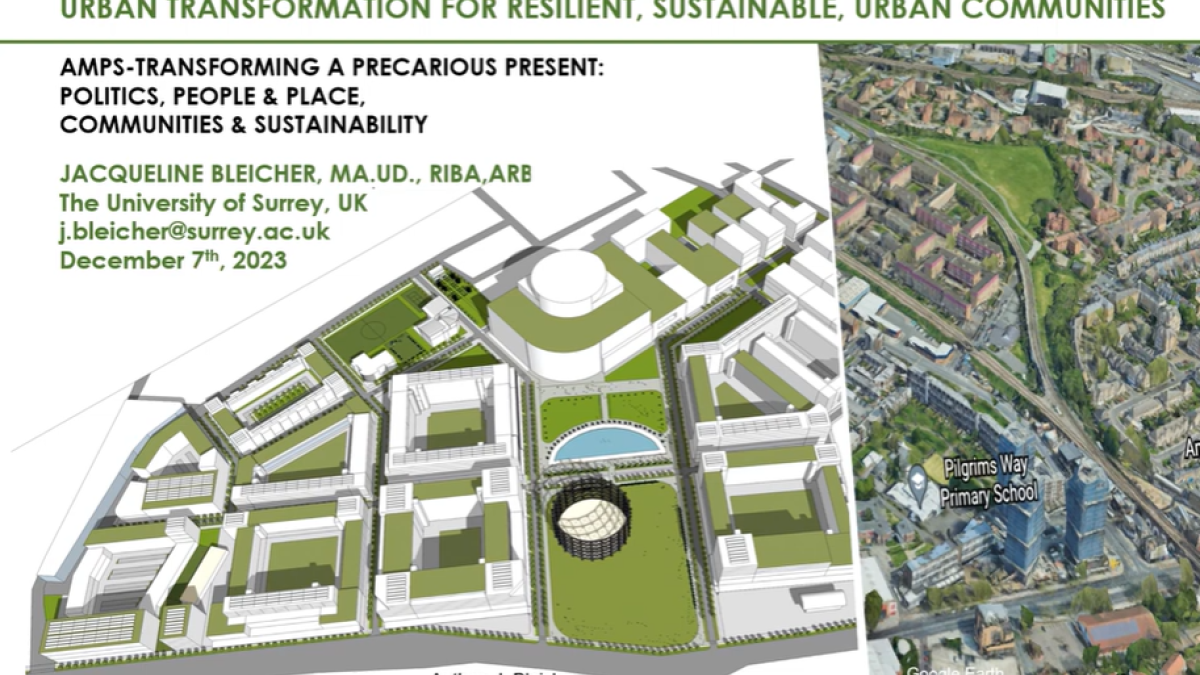
I tested the principles on an urban brownfield site in Southwark London. I produced a concept proposal for a ten-minute, walkable compact, mixed use, complete, liveable neighbourhood. I designed a place with a new significant green space at its heart and added 6000 new homes while retaining existing land uses. The concept proposal encompassed 50.2 hectares or 124.2 acres. I used SketchUp to design and create visuals and a 3D model of the scheme. This experiment was pivotal to my seeking to conduct further research on Urban Transformation Approaches for Sustainable Communities, as a post graduate researcher.
Research interests
My research interests include:
- Climate Change Resilient, Sustainable Urban Neighbourhoods
- Climate Change Hazard Mitigation and Adaptation
- Climate Change resilience and Sustainability of the Urban Built Environment and Natural Environment
- Urban Design led Urban Transformation
- Multicultural, Equitable, safe, healthy, just and inclusive Societies
Research projects
Practice based Research
Post the UK Covid-19 Lock down, in response to a placemaking competition, we the former Directors and former Associates of Global Urban Design CIC, developed 6 principles for future communities. The principles were based on online survey feedback on homes and neighbourhoods, from primarily London residents.
I tested the principles on an urban brownfield site in Southwark London. I produced a concept proposal for a ten-minute, walkable compact, mixed use, complete, liveable neighbourhood. I designed a place with a new significant green space at its heart and added 6000 new homes while retaining existing land uses. The concept proposal encompassed 50.2 hectares or 124.2 acres. I used SketchUp to design and create visuals and a 3D model of the scheme. This experiment was pivotal to my seeking to conduct further research on Urban Transformation Approaches for Sustainable Communities, as a post graduate researcher.
Teaching
Presently, I am not teaching.
Sustainable development goals
My research interests are related to the following:


Publications
Highlights
Jacqueline Bleicher, Prashant Kumar (2025)A Novel Framework integrating Resilient and Sustainable Urbanism for Designing Climate Resilient Sustainable Urban Neighbourhoods, In: Sustainable Cities and Society130106577 Elsevier
Jacqueline Bleicher (2023)Urban transformation for resilient, sustainable communities, In: Amps-Proceedings-Series-37.1 Local Cultures – Global Spaces Communities, People and Placepp. 130-142 AMPS